Lectures
We introduce the topic with various presentations on neurodivergence. This also includes information on the meaning of the term and how it differs from neurodiversity. Although neurological diversity is also evident in, e.g., dyslexia, dyscalculia or Tourette's syndrome, two presentations will focus on the manifestations currently receiving the most public attention: ADHD and autism.
All presentations will take place at Digital Hub, Am Hauptbahnhof 6, 53111 Bonn, in the Silicon Valley room. The premises are accessible for people with limited mobility via an elevator. An accessible restroom and a FLINTA* restroom are available.
The event can also be attended online via Zoom. You will receive the link after registration.
The event will be held in German. If needed, you can request an English translation during registration.
Registration and time
Date and times
Monday, May 18, 2026
1:30 p.m. - 5:00 p.m.
Registration
Pleaser register by May 6, 2026
Note
We want to make the event as neurodivergent-friendly as possible. This includes providing a variety of seating options, as well as opportunities for stimming, moving around, leaving the room, using fidget toys, and so on.
Please note that an assistance dog will be present on May 18 to assist one of the participants.
'Who defines normal? - Neurodivergence at the interplay of pathology, paradigm shift and inclusion'
Introductory lecture on neurodiversity and neurodivergence
Neurodiversity is a topic of increasing importance and raises fundamental questions about normality, diagnosis and aspects of participation, especially in the context of education and higher education. The lecture introduces the concept of neurodiversity and sheds light on the diversity of neurological manifestations beyond ADHD and autism. The focus of the lecture is on the interplay of pathologization, diversity perspectives and social pressure to conform according to the norm. Many educational and career paths remain structurally difficult for neurodivergent individuals and often lead to a mental overload or other health-related consequences. At the same time, academic education offers the freedom to organize tasks according to one's own neurotype, to pursue intellectual interests and to critically question neuro-normative realities.
1:45 p.m.-2:45 p.m.
Digital Hub (Room San Francisco)
Am Hauptbahnhof 6
53111 Bonn

Maren Frank (she/her)
Diversity trainer & alternative practitioner for psychotherapy – neurodiversity
Maren Frank combines professional expertise in autism spectrum disorders, intellectual giftedness and high sensitivity with 30 years of practical experience in healthcare. As a neurodivergent person and mother of neurodivergent children, she also provides valuable insights, particularly regarding institutional challenges. Her goals include highlighting the diversity of people and their different ways of perception, promoting acceptance and strengthening (neuro)inclusion as a non-negotiable aspect of teaching, counseling, and university culture.
„Neurodivergente Menschen sind nicht falsch, nicht krank. Alle haben ein Recht auf Bildung, Teilhabe. Inklusion bedeutet nicht, Menschen anzupassen – sondern Systeme. Verschieden ist normal.“
Jessica Stazzone Manazza (she/her)
Diversity trainer & coach, queer-migrant activist
Jessica Stazzone Manazza studied economics and business administration and works as a key account manager in the organic food industry. As a trainer and coach, besides queerness and bisexuality, she is specialized in neurodiversity, particularly ADHD and learning management. As a queer, neurodivergent trainer with a migrant background, she is committed to raising awareness of intersectional life realities that are often perceived as “too diverse and complicated.” Jessica is co-founder of the queer migrant initiative “BiPlus Göttingen.”.
„Neurodiversität ist nicht neu, sondern elementarer Bestandteil menschlicher Diversität. Neu sind nur die Begrifflichkeiten sowie die lang benötigten gesellschaftlichen und medizinischen Fortschritte.“

'ADHD in adulthood – challenges and chances'
As Director of the Clinic and Polyclinic for Psychiatry and Psychotherapy at the University Hospital Bonn (UKB) and Deputy Medical Director at UKB, Prof. Dr. Alexandra Philipsen describes the clinical presentation of ADHD, identifies key characteristics, explains the diagnostic process and provides information on causes and prevalence. The lecture offers insights into why the number of diagnoses in girls and women is currently rising sharply and points out the underlying reasons. At the same time, she highlights ways of coping (well) with ADHD in everyday life and the treatment options available.
3:00 p.m.-3:45 p.m.
Digital Hub (Room San Francisco)
Am Hauptbahnhof 6
53111 Bonn

Prof. Dr. Alexandra Philipsen
Director of the Clinic of Psychiatry and Psychotherapy at University Hospital Bonn (UKB),
Deputy Medical Director at UKB
Prof. Philipsen's scientific focus lies in therapy research about attention and emotion regulation, as well as in the development and evaluation of innovative pharmacological and non-pharmacological therapies, particularly for ADHD in adults. Her clinical focus includes the diagnosis and treatment of the entire spectrum of mental illnesses, in particular affective disorders such as depression, stress-related illnesses, ADHD in adults and personality disorders.
'Superpower, subclinic, studying – autism at university'
Beccs Riley's lecture introduces the development of the neurodivergence paradigm and clarifies what autism actually means in the context of human neurological diversity. From there, it can be derived why the term autism spectrum and the related categorization are so important and what this means for subclinical forms. From an activist perspective, the lecture highlights the identity-shaping feeling of being equipped with a different operating system as compared with the majority of society. What does it mean for higher education when autistic brains function differently than allistic ones?
4:15 p.m.-5:00 p.m.
Digital Hub (Room San Francisco)
Am Hauptbahnhof 6
53111 Bonn
Beccs Riley (es/nin)
Founder of Minzgespinst and DEIB Consultant*
Communication, conflicts, and related issues such as bullying are topics Beccs is passionate about. As an autistic person with a background in systemic work, Beccs advises companies, organizations and individuals especially when different, neurodiverse needs clash and threaten to escalate (or after they have escalated). Beccs founded the association Minzgespinst e.V., which connects people from different backgrounds and life paths to work together for an inclusive and fair society. The aim of the network is to raise awareness of autism, gender equality and to strengthen the diversity of human experiences.
"Wir sind Linux Distributionen in einer Welt, in der Apple MacOS erfunden hat."

Host
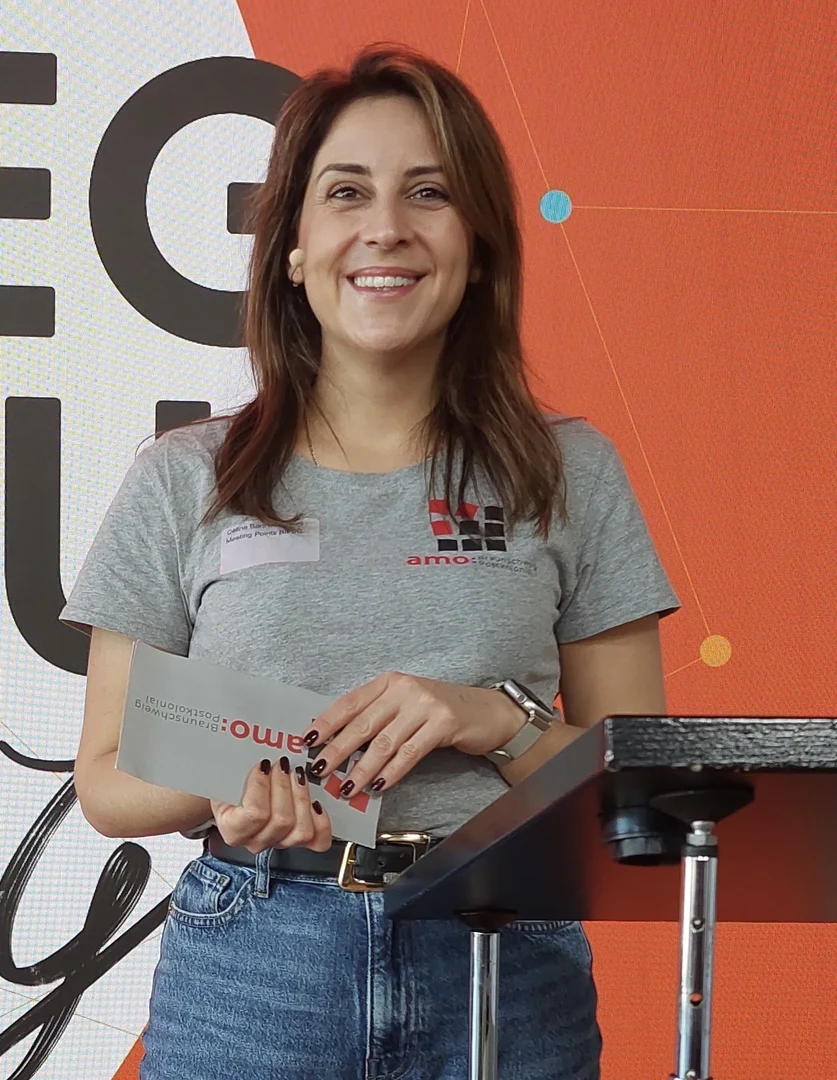
Céline Bartholomaeus (she/her)
Theatre maker, activist & educator
Céline Bartholomaeus works at the intersection of art and political education. In her work, she focuses on empowerment, inclusion and the critique of power, and designs a variety of formats for engagement – from workshops and facilitation to event curation – always with a focus on diversity.
As a neurodivergent person, she brings in lived experience and combines artistic and practical work with discursive, knowledge-based communication in her practice. An insight into her projects can be found at kritikundkreppband.de.
Awareness & Accessibility
Awareness means consciousness and becoming sensitized in our interactions with each other. Awareness stands for appreciative and respectful interaction aiming to recognize and eliminate discriminatory and unacceptable behavior. It implies taking responsibility for oneself and for one another in order to create a safe atmosphere in which everyone feels comfortable and where personal boundaries are respected.
We also expect respectful interaction and a neurodivergence-friendly attitude of the participants attending the lectures and workshops during the Diversity Days.
Also, an awareness team will be present at the event and can be approached at any time with questions or problems. They can be recognized by their lanyards.
If you have any questions about awareness, please feel free to contact us in advance: e.kilian@uni-bonn.de.
Please find below:
Cooperation Agreements
Awareness Guidelindes
The premises of both venues are accessible to persons with limited mobility via an elevator. An accessible restroom and a FLINTA* restroom are available. Please indicate on the registration form if you require additional assistance. We will gladly accommodate your needs during to the event.
The presentations on the first day will be translated into German Sign Language (DGS). If required, an English translation can be provided (please see registration form).
On the second day, there will be no translation services.
The event is explicitly organized in a neurodivergence-friendly way. Different seating options are provided. Stimming, moving around, leaving the room and using fidget toys are explicitly permitted. Please note that the specific needs of different persons can be contradictory. For example, the lights will not be dimmed, as this makes it difficult for visually impaired people to participate. You are welcome to indicate any special needs on the registration form. We are happy to assist you in attending the event.
For all Diversity Days events, the Family Office is providing childcare in the parent-child room at the Deutscher Herold.
Some of the topics addressed during the event may trigger strong emotions in some individuals. These topics include ableism, diagnostics and psychiatry experiences.
An awareness team will be on site to provide support if needed.
Contact and Organization

Julia Lindenberg (she/her)
Dechenstraße 3-11
53115 Bonn
Ruth Ellen Bischoff (she/her)
Dechenstraße 3-11
53115 Bonn